2. MATERIALS
2.1. PSIM Simulation Software
PSIM [10] is an Electronic circuit simulation software package, designed specifically for use in power electronics and motor drive simulations but can be used to simulate any electronic circuit. Developed by Powersim, PSIM uses nodal analysis and the trapezoidal rule integration as the basis of its simulation algorithm. PSIM provides a schematic capture interface and a waveform viewer Simview. PSIM has several modules that extend its functionality into specific areas of circuit simulation and design including control theory, electric motors, photovoltaics and wind turbines. PSIM is used by industry for research and product development and it is used by educational institutions for research and teaching. There are modules that enable motor drive simulation, digital control, and the calculation of thermal losses due to switching and conduction. There is a renewable energy module which allows for the simulation of photovoltaics (including temperature effects), batteries, supercapacitor, and wind turbines. See Figure 2.1.

Figure 2-1 PSIM Software interface [10]
2.2. MATLAB Simulink
Simulink [11] is a MATLAB-based graphical programming environment for modeling, simulating, and analyzing multidomain dynamical systems. Its primary interface is a graphical block diagramming tool and a customizable set of block libraries. It offers tight integration with the rest of the MATLAB environment and can either drive MATLAB or be scripted from it. Simulink is widely used in automatic control and digital signal processing for multidomain simulation and model-based design. See Figure 2.2.

Figure 2-2 MATLAB Simulink interface [11]
2.3. EAGLE Autodesk
EAGLE [12] is a scriptable electronic design automation (EDA) application with schematic capture, printed circuit board (PCB) layout, auto-router and computer-aided manufacturing (CAM) features. EAGLE stands for Easily Applicable Graphical Layout and is developed by CadSoft Computer GmbH. EAGLE contains a schematic editor, for designing circuit diagrams. Schematics are stored in files with .SCH extension, parts are defined in device libraries with .LBR extension. Parts can be placed on many sheets and connected together through ports. The PCB layout editor stores board files with the extension .BRD. It allows back-annotation to the schematic and auto-routing to automatically connect traces based on the connections defined in the schematic. In this thesis, circuit diagram and PCB designs implemented on this program. See Figure 2.3.

Figure 2-3 EAGLE Autodesk interface [12]
2.4. Python and Spyder
Python [13] is an interpreted, high-level, general-purpose programming language. Python’s design philosophy emphasizes code readability with its notable use of significant whitespace. Its language constructs and object-oriented approach aims to help programmers write clear, logical code for small and large-scale projects. Python is dynamically typed and garbage-collected. It supports multiple programming paradigms, including procedural, object-oriented, and functional programming. Python is often described as a “batteries included” language due to its comprehensive standard library.
Spyder [14] is a powerful scientific environment written in Python, for Python, and designed by and for scientists, engineers, and data analysts. It features a unique combination of the advanced editing, analysis, debugging and profiling functionality of a comprehensive development tool with the data exploration, interactive execution, deep inspection, and beautiful visualization capabilities of a scientific package. Furthermore, Spyder offers built-in integration with many popular scientific packages, including NumPy, SciPy, Pandas, IPython, QtConsole, Matplotlib, SymPy, and more. Beyond its many built-in features, Spyder can be extended even further via third-party plugins. Spyder can also be used as a PyQt5 extension library, allowing you to build upon its functionality and embed its components, such as the interactive console or advanced editor, in your own software. Python programming language is used for the analysis of the consumption data. See Figure 2.4.
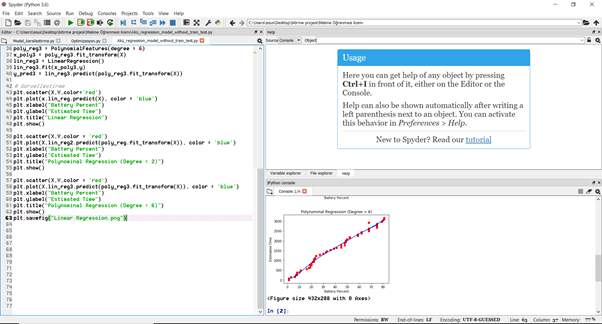
Figure 2-4 Spyder interface [14]
References:
10. PSIM (Online) https://powersimtech.com/products/psim/
11. MATLAB Simulink (Online) https://www.mathworks.com/products/simulink.html
12. Eagle (Online) https://www.autodesk.com/products/eagle/overview

 Turhan Can Kargın