In the fast-paced world of retail, predicting which products will capture the market’s attention is more than just a guessing game; it’s a science. This is where the power of neural networks comes into play, transforming vast amounts of data into actionable insights. At the heart of this transformation is the ability to accurately predict demand, ensuring retailers can make informed decisions on inventory levels and marketing strategies. But what exactly are neural networks, and how do they manage to turn data into predictions?
Neural networks are a cornerstone of artificial intelligence (AI), inspired by the complexity of the human brain. They are composed of interconnected units or “neurons” that process information in a manner reminiscent of the neural pathways in our minds. These networks are capable of learning from data, making them exceptionally versatile in solving problems that involve recognizing patterns or predicting future events.
In the realm of retail, the application of neural networks in demand prediction exemplifies their potential. By analyzing factors such as product features, historical sales data, and market trends, these AI models can forecast whether a new or existing product will become a top seller. This capability allows retailers to optimize their inventory and focus their marketing efforts on products with the highest potential for success.
As we delve deeper into the workings of neural networks, we’ll explore how they evolve from basic models to complex systems capable of making highly accurate predictions. Through the lens of demand prediction for retail products, like T-shirts, we’ll uncover the intricate layers and processes that enable neural networks to analyze and interpret data, ultimately providing valuable predictions that can drive business success.

In the following sections, we will break down the foundational elements of neural networks, illustrate their function through practical examples, and discuss how they are constructed and trained to make predictions. By understanding these principles, we can appreciate the remarkable capabilities of neural networks and their transformative impact on demand prediction and beyond.
Section 1: The Basics of Neural Networks
At their core, neural networks are a series of algorithms aimed at recognizing underlying relationships in a set of data through a process that mimics the way the human brain operates. Though they are inspired by our biological neural networks, the parallels are more functional than literal. Let’s unpack these concepts to understand the fundamental principles of how neural networks work, especially in applications like demand prediction.

Understanding Neurons and Activation
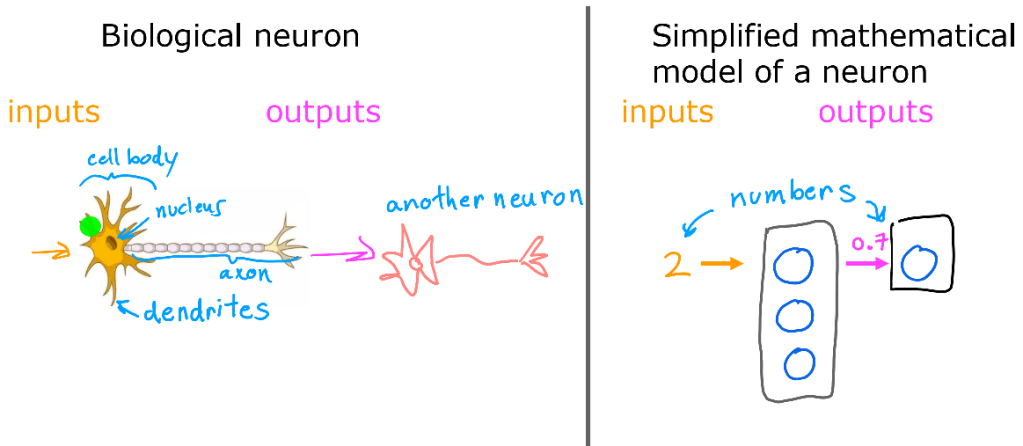
The basic building block of a neural network is the neuron, or node, which in many ways acts like its biological counterpart. Each neuron receives input (data), processes it, and passes on an output. In the context of neural networks, this input is typically a numerical value which the neuron processes using a weighted sum that is then passed through an activation function.
The activation function is critical; it determines whether the neuron will “fire” or not. This function can transform the weighted sum of the input into a format that is suitable for output to the next layer in the network. One common example of an activation function is the sigmoid function, which squashes the output to a range between 0 and 1, making it useful for binary classification problems—like predicting whether a T-shirt will be a top seller or not.
Logistic Regression as a Neuron
Logistic regression can be thought of as a simple neural network: it takes inputs, applies a set of weights, adds a bias, and finally applies an activation function (in this case, the sigmoid function). This process outputs a probability that the given input belongs to a certain class. In our T-shirt example, logistic regression could help predict the probability of a T-shirt being a top seller based on its price alone.
This analogy helps demystify neural networks. If logistic regression is a single neuron capable of making predictions based on input data, a neural network is simply a collection of these neurons arranged in layers, working together to process input data in more complex ways.
From Simple to Complex
A key aspect of neural networks is their ability to learn. Through a process known as “training,” a neural network adjusts its weights and biases to minimize the difference between its predictions and the actual outcomes. This learning process is what allows the network to improve its predictions over time.
The simplicity of a single logistic regression model gives way to the complexity and power of neural networks when we consider multiple inputs and outputs. For instance, predicting the demand for a T-shirt might not rely solely on price but also on factors like shipping costs, marketing efforts, and material quality. A neural network can take all these inputs into account, processing them through multiple neurons (or logistic regression models) to predict demand more accurately than any single neuron could.
In essence, the basics of neural networks revolve around understanding these individual components—the neurons—and how they come together to form networks capable of learning and making predictions. This foundational knowledge sets the stage for exploring more intricate aspects of neural networks, such as how they are structured into layers and how these layers interact to process information.
By starting with the simple concept of logistic regression as a neuron and building up to the complex architecture of neural networks, we can appreciate the sophistication of these models and their potential to revolutionize demand prediction in retail and many other fields.
Section 2: Building Blocks of a Neural Network
Diving deeper into the architecture of neural networks, it becomes apparent that their strength lies in the intricate arrangement of their basic components. These components, or “building blocks,” are organized into layers that collectively process input data, learn from it, and make predictions. Understanding the roles and functions of these layers is crucial for comprehending how neural networks achieve their complex tasks.
Input Layer: The Gateway
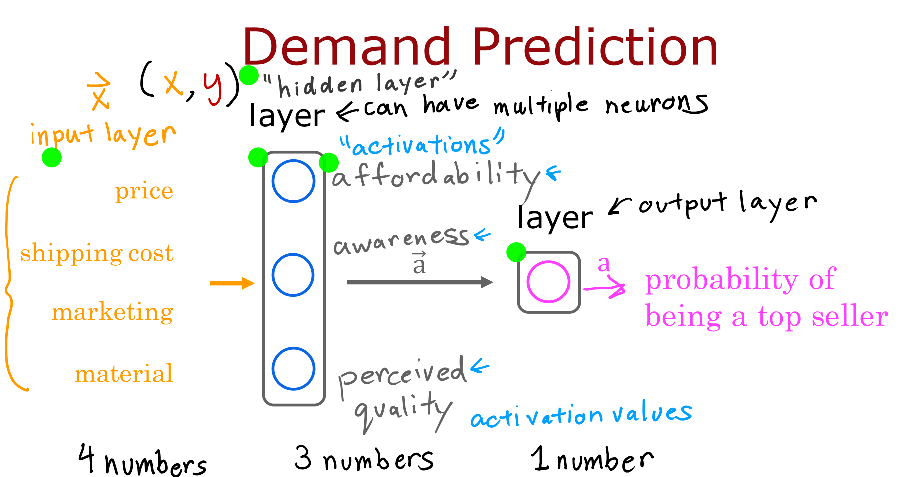
The input layer serves as the gateway for data entering the neural network. Each neuron in this layer represents a feature of the input dataset. For example, in demand prediction for a T-shirt, the features might include price, shipping cost, marketing expenditure, and material quality. The input layer directly receives values for these features and passes them on to the next layer without any processing, acting merely as a conduit.
Hidden Layers: The Processors
At the heart of a neural network lie one or more hidden layers, which are pivotal in the network’s ability to learn and make predictions. Unlike the input layer, neurons in hidden layers perform significant processing on the received data. They apply weights to the inputs, add biases (to adjust the output along the value scale), and pass the result through an activation function. This transformation of data is where the learning happens; the network adjusts the weights and biases as it learns, improving its predictions over time.
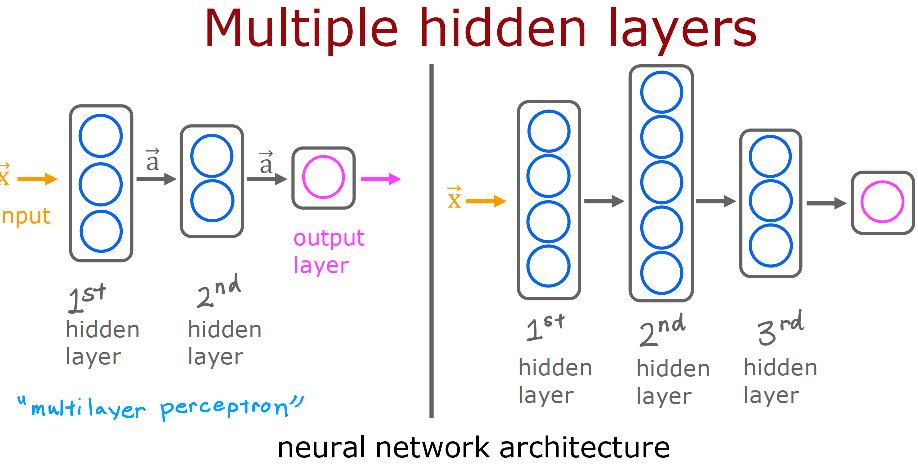
The complexity of a neural network is partly determined by the number of hidden layers it contains and the number of neurons within those layers. More layers and neurons can allow the network to capture more intricate patterns in the data, but they also make the network more complex and computationally intensive.
Output Layer: The Predictor
The final layer of a neural network is the output layer, which presents the network’s predictions based on the input data. The structure of the output layer—specifically, the number of neurons it contains—depends on the task at hand. For binary classification tasks, like predicting whether a T-shirt will be a top seller, a single neuron is often sufficient. This neuron might output a probability score, derived through an activation function like the sigmoid, indicating the likelihood of the T-shirt being a top seller.
Activation Functions: The Decision Makers
Activation functions are fundamental to the operation of neural networks. They decide whether a neuron should be activated or not, based on the weighted sum of the inputs it receives. Different functions can be used, each with its own characteristics and applications. The sigmoid function, for example, is great for binary classifications, while others like the ReLU (Rectified Linear Unit) function are more commonly used in hidden layers of deep neural networks due to their computational efficiency and ability to address the vanishing gradient problem.
The Symphony of Layers
A neural network’s power comes from the collective operation of its layers. Data flows from the input layer, through one or more hidden layers, to the output layer. At each step, the data is transformed, with the hidden layers extracting and refining features that are predictive of the outcome. This process allows neural networks to tackle complex problems that simpler models, like logistic regression, cannot handle on their own.
By orchestrating the input, hidden, and output layers, along with carefully chosen activation functions, neural networks can model complex relationships in data. This ability to learn from and adapt to the data makes neural networks incredibly effective for a wide range of applications, from demand prediction in retail to more advanced tasks like image recognition and natural language processing.
Section 3: Complex Neural Network for Demand Prediction
Transitioning from the foundational principles of neural networks, we now delve into the complexities of applying these networks for the specific task of demand prediction. Retailers, aiming to discern the potential top-selling products, require a predictive model that can process multiple variables. A simple logistic regression model, acting as a solitary neuron, provides a starting point. However, real-world scenarios demand a more nuanced approach, considering multiple factors such as price, shipping costs, marketing efforts, and material quality. This necessitates the evolution from a single-neuron model to a complex neural network architecture.
Incorporating Multiple Features
In the domain of demand prediction, it’s evident that a product’s success isn’t hinged on a single attribute. A neural network that predicts demand for T-shirts, for example, would benefit from considering various features: price, shipping costs, marketing intensity, and material quality. The complexity and interrelation of these features make them ideal for analysis through a neural network, which can process and weigh these inputs in a nuanced manner.
Structuring the Neural Network
The neural network designed for this task might begin with an input layer comprising nodes for each feature: price, shipping costs, marketing, and material quality. This is where the network starts its computation, taking the raw data as input.
To process these inputs effectively, we introduce a hidden layer—or, more likely, multiple hidden layers—each consisting of neurons that perform weighted computations on the inputs. These neurons might be tasked with evaluating specific aspects related to the demand prediction, such as affordability, awareness, and perceived quality.
- Affordability Neuron: This neuron might focus on the price and shipping costs, providing an estimate of the product’s affordability to potential buyers.
- Awareness Neuron: Another neuron could assess the marketing efforts to determine the level of consumer awareness regarding the T-shirt.
- Perceived Quality Neuron: A third neuron might analyze both the price (as a proxy for quality in consumer perception) and the actual material quality to estimate how consumers perceive the product’s quality.
From Features to Final Prediction
The outputs of these neurons, which we can consider as assessments of affordability, awareness, and perceived quality, are then fed into another layer. This might be a single neuron or a layer of neurons that consolidates these insights to produce a final prediction: the likelihood of the T-shirt being a top seller.
This process exemplifies the power of neural networks to not just process raw data, but to synthesize and interpret complex interrelations between multiple factors. Each neuron’s output provides a nuanced understanding of a particular aspect of the product, which the final layer integrates into a holistic prediction.
The Neural Network’s Predictive Journey
What stands out in this complex neural network for demand prediction is its ability to learn and adapt. Through training, the network adjusts its weights and biases based on the accuracy of its predictions, honing its ability to forecast demand more precisely over time. This adaptability is crucial in the ever-changing retail landscape, where consumer preferences and market dynamics are in constant flux.
In sum, the leap from basic neural network principles to their application in demand prediction showcases the versatility and depth of neural networks. By analyzing multiple inputs through a structured series of layers and neurons, these networks offer a powerful tool for making informed predictions, enabling retailers to strategize inventory and marketing with unprecedented precision.
Section 4: Understanding Layers and Their Functions
Diving deeper into the architecture of neural networks, it becomes crucial to understand the distinct roles played by different layers within the network. These layers collectively process inputs to produce outputs, but each has a unique function in the overall computation process. This section will elucidate the structure and purpose of input, hidden, and output layers in the context of neural networks, particularly those designed for complex tasks like demand prediction.
The Input Layer: The Gateway
The input layer serves as the gateway through which data enters the neural network. It consists of neurons equal in number to the features considered for the prediction. For a demand prediction model concerning T-shirts, these features might include price, shipping costs, marketing expenditure, and material quality. Each neuron in the input layer represents one of these features, ready to process the raw data fed into the network.
Hidden Layers: The Processing Powerhouse
Beneath the surface, hidden layers form the core of a neural network’s processing capability. These layers, which can vary in number, contain neurons that perform complex computations on the inputs received from the layer before them. Each neuron in a hidden layer applies a weighted sum to its inputs, followed by an activation function to introduce non-linearity, allowing the network to learn and model complex relationships between the inputs and the target prediction.
In the example of T-shirt demand prediction, hidden layers would analyze the relationships between various features like price and material quality against consumer perceptions of affordability, awareness, and quality. Neurons in these layers might be dedicated to understanding how different combinations of features affect the likelihood of a product becoming a top seller. The arrangement of neurons in hidden layers allows the network to abstract and refine the information passed from the input layer, gradually shaping it into a form that the output layer can use for making a final prediction.
The Output Layer: Delivering the Prediction
The culmination of a neural network’s processing effort is the output layer. This layer’s primary function is to take the highly processed information from the last hidden layer and translate it into a format that answers the question at hand. For demand prediction, the output layer might consist of a single neuron if the goal is to predict a binary outcome (top seller or not). This neuron would output a probability score, derived from the activations passed down from the hidden layers, indicating the likelihood of a T-shirt being a top seller.
The Role of Activations
Throughout the network, from input to output layers, the concept of activation plays a pivotal role. Activation functions determine how a neuron’s weighted input is transformed into an output. Whether it’s a sigmoid function producing a binary outcome or a ReLU (Rectified Linear Unit) encouraging non-linear processing in hidden layers, activations ensure the network can capture complex patterns in the data.
Why Layers Matter
The layered architecture of neural networks is not arbitrary. It allows for the structured processing of information, where each layer can be thought of as performing a specific task or focusing on a particular aspect of the data. This modularity facilitates learning hierarchical representations of the data, with each layer building on the abstractions formed by the previous ones.
In the grand scheme of things, understanding the distinct functions of input, hidden, and output layers, along with the role of activations, equips us with a deeper comprehension of how neural networks manage to perform tasks as complex as demand prediction. By dissecting these layers and their functions, we gain insight into the intricate workings of neural networks and appreciate the sophisticated manner in which they approach problem-solving.
Section 5: Neural Networks in Action
Having navigated through the theoretical landscape of neural networks, including their structure and function, it’s time to witness these computational marvels in action. Specifically, we’ll focus on how they apply to the realm of demand prediction, turning theoretical constructs into practical tools that drive decision-making in the retail sector. This section will illustrate the journey from input data through the neural network to a predictive outcome, emphasizing the transformative power of these models in forecasting demand.
From Data to Decision: A Practical Example
Imagine a scenario where a retailer seeks to predict the demand for a new line of T-shirts. The retailer has historical data on various features such as price, shipping costs, marketing expenditure, and material quality, alongside records of which T-shirts were top sellers. This data set serves as the foundation upon which our neural network will learn and make predictions.
- Input Layer Receives Data: The process begins with the input layer, where each neuron corresponds to one of the features (e.g., price, shipping costs). The raw data for a new T-shirt enters the network through this layer, initiating the prediction process.
- Hidden Layers Analyze and Process: As the data moves into the hidden layers, it undergoes a transformation. These layers, equipped with neurons that apply weights and activation functions, start deciphering the complex relationships between the features. For example, one neuron might begin to understand the impact of pricing strategy on sales, while another focuses on the influence of marketing efforts.
- Output Layer Predicts Demand: The final prediction emerges at the output layer. Here, the processed data from the hidden layers culminates in a single value or classification—predicting whether the T-shirt will be a top seller. This prediction is based on the network’s learned patterns and the specific features of the T-shirt in question.
Learning and Adapting: The Power of Neural Networks
A neural network’s ability to predict demand stems from its learning process, where it adjusts the weights applied to features based on the accuracy of its predictions. Through training with a dataset of T-shirts that were and were not top sellers, the network refines its predictions, striving for accuracy. This adaptability is key to its success in a constantly changing market environment.
Beyond Prediction: Insights and Strategy
The implications of a neural network’s predictions extend beyond mere forecasts. Retailers can use these insights to make strategic decisions, such as adjusting inventory levels, tailoring marketing campaigns, or even influencing product design. The predictive power of neural networks thus becomes a cornerstone of business strategy, enabling data-driven decisions that align closely with market demands.
Illustrating Neural Networks’ Versatility
While demand prediction for T-shirts serves as a relatable example, the application of neural networks spans a vast array of industries and challenges. From diagnosing medical conditions based on patient data to optimizing logistics in supply chain management, the principles remain consistent. Neural networks take complex, multifaceted data and distill it into actionable predictions and insights.
Neural Networks in Practice
The practical application of neural networks in demand prediction showcases their remarkable capacity to process and analyze data in a way that mimics human intuition but at a scale and speed unattainable by humans alone. As we’ve seen, the journey from input data to predictive outcome is both complex and fascinating, underscoring the transformative potential of neural networks across various sectors. By harnessing this potential, businesses and organizations can unlock new levels of efficiency, accuracy, and strategic foresight, propelling them toward data-informed decision-making and success in their respective fields.
Section 6: Expanding Neural Network Complexity
As we delve deeper into the capabilities of neural networks, it becomes apparent that their potential extends far beyond simple models. By expanding the complexity of these networks through additional layers and neurons, we unlock new levels of abstraction and learning capability. This progression enables neural networks to tackle more intricate problems with greater accuracy, making them invaluable tools in a variety of domains, including but not limited to demand prediction. This section explores how increasing the complexity of neural networks enhances their performance and application scope.
Multilayer Perceptrons (MLPs)
At the heart of expanding neural network complexity lies the concept of Multilayer Perceptrons (MLPs). MLPs are a class of feedforward artificial neural networks that contain one or more hidden layers of neurons, unlike a single-layer perceptron that only has an input and an output layer. The addition of multiple hidden layers allows MLPs to learn more complex patterns in the data.
Deep Learning: Embracing Complexity for Enhanced Learning
Deep learning refers to neural networks with a significant number of layers, often designed to learn levels of representation and abstraction that make sense of data such as images, sound, and text. As we increase the number of hidden layers, we give the network more opportunities to understand complex relationships within the data. Each layer can learn to recognize different features, from simple to complex, building a comprehensive hierarchy of features.
For instance, in demand prediction, the first hidden layer might identify basic patterns related to pricing and sales volume, while deeper layers could interpret more complex interactions between pricing, customer reviews, seasonal trends, and marketing strategies. This depth enables the network to make predictions based on a nuanced understanding of the data.
Challenges of Increased Complexity
While adding layers to a neural network can enhance its learning capability, it also introduces new challenges:
- Overfitting: A network with too many parameters might learn to memorize the training data, reducing its ability to generalize to new, unseen data. Regularization techniques and dropout are common strategies to combat overfitting.
- Training Difficulties: Deeper networks can be harder to train. Issues like vanishing or exploding gradients might occur, where the gradients used in updating the network’s weights become too small or too large, respectively. Advanced optimization techniques and specialized architectures like ResNets have been developed to address these challenges.
- Computational Resource Requirements: More layers and neurons require more computational power and memory for both training and inference. This can increase the cost and time needed to develop and deploy neural network models.
Architectural Innovations
The field of neural networks is rich with architectural innovations that address the challenges of complexity while harnessing its benefits. Convolutional Neural Networks (CNNs) are optimized for image data, while Recurrent Neural Networks (RNNs) and their variants like Long Short-Term Memory (LSTM) networks are suited for sequential data such as time series or natural language.
Tailoring Complexity to the Task
Determining the optimal architecture for a neural network—how many layers and neurons to include—is more an art than a science. It involves balancing the need for model complexity with the risk of overfitting and computational feasibility. Cross-validation, a technique where the training data is split into smaller subsets to validate the model’s performance, can help in choosing the right architecture.
Leveraging Complexity for Advanced Predictions
The expansion of neural network complexity opens doors to solving previously intractable problems. In demand prediction and beyond, the strategic increase in network depth and breadth allows for more accurate, nuanced predictions. As we continue to push the boundaries of what neural networks can achieve, we also refine our approaches to model training and architecture design, ensuring that the increase in complexity translates into tangible benefits. This ongoing evolution of neural networks highlights their central role in advancing AI and machine learning, promising even more sophisticated applications and insights in the future.
Conclusion
The exploration of neural networks, from their basic principles to their complex applications in demand prediction and beyond, showcases a fascinating blend of computational ingenuity and practical utility. These models, inspired by the workings of the human brain, have evolved from simple structures to sophisticated systems capable of understanding and predicting patterns in data with remarkable accuracy. The journey through the various layers of a neural network, the strategic expansion of its complexity, and the practical implications of its predictions, illuminates the transformative potential of neural networks across industries.
The Transformative Impact of Neural Networks
Neural networks have not only revolutionized the way we approach demand prediction in retail but have also paved the way for advancements in numerous other fields. From healthcare, where they enable early diagnosis and personalized treatment plans, to finance, where they contribute to fraud detection and algorithmic trading strategies, neural networks are at the forefront of technological innovation. Their ability to process and learn from vast amounts of data has made them invaluable in driving efficiency, enhancing accuracy, and uncovering insights that were previously inaccessible.
The Road Ahead: Challenges and Opportunities
As we advance in our ability to construct and train more complex neural networks, we also face challenges related to overfitting, computational demands, and the ethical implications of AI. Addressing these challenges requires a concerted effort from researchers, practitioners, and policymakers to ensure that the development and deployment of neural networks are guided by principles of fairness, transparency, and accountability.
The future of neural networks holds promise for even greater achievements. With ongoing advancements in computing power, algorithmic efficiency, and data availability, we stand on the cusp of unlocking new capabilities and applications. Innovations in network architecture, such as attention mechanisms and transformer models, hint at the untapped potential of neural networks to further enhance our understanding of complex data patterns.
Final Thoughts
Neural networks embody the remarkable progress we’ve made in artificial intelligence, offering tools that can learn from and adapt to the world around them. As we continue to explore the depths of their capabilities, we are reminded of the power of human ingenuity to create technologies that can augment our abilities and expand our horizons. The journey of understanding and applying neural networks is far from complete, but it is a path laden with opportunities to reshape our world for the better.
By harnessing the power of neural networks, we are not just predicting demand or classifying images; we are paving the way for a future where AI supports and enhances human decision-making across all facets of life. The exploration of neural networks is a testament to our relentless pursuit of knowledge and our unwavering commitment to leveraging technology for the greater good. As we look forward, the potential of neural networks to transform our world is limited only by our imagination and our willingness to venture into the unknown.
If you want to understand how to code neural networks, I highly recommend the following video by Andrej Karpathy.

 Turhan Can Kargın