ABSTRACT
In this project, an optimal design procedure of inductor-inductor-capacitor (LLC) resonant DC-DC converter is developed for uninterruptible power supply (UPS) battery charge applications based on high power efficiency. The LLC resonant converters have many advantages such as high-power efficiency and less switching losses when compared with other converters features. It is also capable of operating in narrow switching frequency where zero voltage switching can be provided. The DC-DC converter with 400V input and 48V/3.1A output has been selected as an experimental setup. In order to reach optimal design of LLC resonant converter and required output values, switching frequency might be determined as above of resonance frequency, based on theoretical calculations and Power Electronics Simulation package program. The obtained maximum power efficiency with the proposed method was measured as 95.22%. Besides, charge-discharge models of the battery were obtained from the battery data obtained via deriving regression models with machine learning algorithms where battery electrical energy consumptions, battery status, and temperature data can be analyzed. score and root mean square error tests are performed for ten different regression models. Random forest regression is determined as the best model among regression models for the obtained data set.
1. INTRODUCTION
The growing demand for higher power density and low profile in power converter designs has forced designers to increase switching frequencies. Operation at higher frequencies considerably reduces the size of passive components such as transformers and filters. However, switching losses have been an obstacle to high frequency operation. In order to reduce switching losses, allowing high frequency operation, resonant switching techniques have been developed. These techniques process power in a sinusoidal manner and the switching devices are softly commutated. Therefore, the switching losses and noise can be dramatically reduced. Conventional resonant converters use an inductor in series with a capacitor as a resonant network. Two basic configurations are possible for the load connection: series connection and parallel connections [1]. See Figure 1.1.
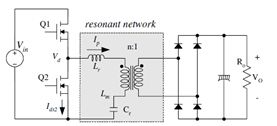
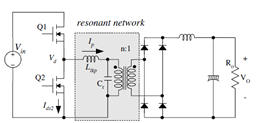
Figure 1-1 Half-bridge series and parallel resonant converters [1]
These two different resonant converters have some limitations. For SRC, the rectifier-load network is placed in series with the L-C resonant network [2-4]. From this configuration, the resonant network and the load act as a voltage divider. By changing the frequency of driving voltage , the impedance of the resonant network changes. The input voltage will be split between this impedance and the reflected load. Since it is a voltage divider, the DC gain of an SRC is always lower than 1. At light load condition, the impedance of the load will be very large compared to the impedance of the resonant network; all the input voltage will be imposed on the load. This makes it difficult to regulate the output at light load. Theoretically, frequency should be infinite to regulate the output at no load. For parallel resonant converter, the rectifier-load network is placed in parallel with the resonant capacitor as depicted [5-7]. Since the load is connected in parallel with the resonant network, there inevitably exists large amount of circulating current. This makes it difficult to apply parallel resonant topologies in high power applications. Therefore, in order to solve the limitations of the conventional resonant converters, the LLC resonant converter has been proposed. The LLC-type resonant converter has many advantages over conventional resonant converters. First, it can regulate the output over wide line and load variations with a relatively small variation of switching frequency. Second, it can achieve zero voltage switching (ZVS) over the entire operating range. Finally, all essential parasitic elements, including junction capacitances of all semiconductor devices and the leakage inductance and magnetizing inductance of the transformer, are utilized to achieve ZVS. See Figure 1.2.
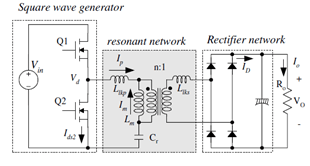
Figure 1-2 A schematic of half-bridge LLC resonant converter [1]
Recently, the LLC resonant converter has drawn a lot of attention due to its advantages over the conventional series resonant converter and parallel resonant converter: narrow frequency variation over wide load and input variation and Zero Voltage Switching (ZVS) of the switches for entire load range. The LLC-type resonant converter has many advantages over conventional resonant converters. First, it can regulate the output over wide line and load variations with a relatively small variation of switching frequency. Second, it can achieve zero voltage switching (ZVS) over the entire operating range. Finally, all essential parasitic elements, including junction capacitances of all semiconductor devices and the leakage inductance and magnetizing inductance of the transformer, are utilized to achieve ZVS. The battery used in Uninterruptible Power Supply should be in such a way that it should satisfy the features such as smooth and quick charging, high power density, high efficiency. Furthermore, battery technology is improving and as this transition occurs, the charging of these batteries becomes very complicated due to the high voltages and currents involved in the system and the sophisticated charging algorithms [8]. The most commonly used battery charging architecture is shown in figure 3. It consists of mainly two stages, namely power factor correction PFC stage and DC-DC converter stage. The power factor correction stage is a continuous conduction mode of boost topology [9]. In this project, the main focus is the DC-DC converter which plays an important role in battery charger by regulating the output current and voltage. See Figure 1.3.
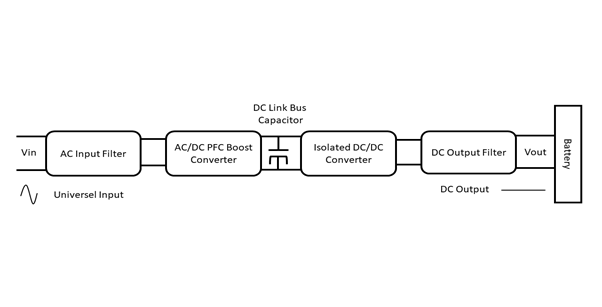
Figure 1-3 Block diagram of a universal battery charger
In this project, an optimal design procedure of inductor-inductor-capacitor (LLC) resonant converter for UPS battery charger applications based on high efficiency and Battery Charge-Discharge regression model is proposed. In the design procedure, 4x12V UPS battery is used. Thus, LLC resonant converter should be regulated the output voltage in a wide voltage range with different load conditions according to typical charging profile of battery. For the design procedure, basic operation characteristics of LLC resonant converter is defined, and operation regions are discussed in terms of high efficiency. The operation regions of LLC resonant converter are discussed to regulate wide output voltage range. Therefore, the purpose of the project is designing and producing an LLC resonant converter that will have 48V/3.1A output values to charge 4 x 12V / 30Ah batteries. The circuit is simulated using PSIM software. PCB design was performed by Eagle Autodesk. In addition, it is presented as secondary output to find the charge-discharge models under varying conditions by deriving the regression models with machine learning algorithms where the battery electricity energy consumption, battery status and temperature data can be analyzed.
REFERENCES
- Design Considerations for an LLC Resonant Converter Hangseok Choi Fairchild Semiconductor 82-3, Dodang dong, Wonmi-gu Bucheon-si, Gyeonggi-do, Korea
- A. F. Witulski and R. W. Erickson, “Design of the series resonant converter for minimum stress,”
- R. Oruganti, J. Yang, and F.C. Lee, “Implementation of Optimal Trajectory Control of Series Resonant Converters,”.
- V. Vorperian and S. Cuk, “A Complete DC Analysis of the Series Resonant Converter,”
- Y. G. Kang, A. K. Upadhyay, D. L. Stephens, “Analysis and design of a half-bridge parallel resonant converter operating above resonance,”
- R. Oruganti, J. Yang, and F.C. Lee, “State Plane Analysis of Parallel Resonant Converters,”
- M. Emsermann, “An Approximate Steady State and Small Signal Analysis of the Parallel Resonant Converter Running Above Resonance,”
- An LLC Resonant DC–DC Converter for Wide Output Voltage Range Battery Charging Applications Fariborz Musavi, Senior Member, IEEE, Marian Craciun, Member, IEEE, Deepak S. Gautam, Student Member, IEEE, Wilson Eberle, Member, IEEE, and William G. Dunford, Senior Member, IEEE
- LLC Resonant Converter for Battery Charging Application G. Subitha Sri and Dr. D. Subbulekshmi School of Electrical Engineering, VIT University, Chennai Associate professor, School of Electrical Engineering, VIT University, Chennai

 Turhan Can Kargın
thanks for sharing a valuable information, for more information logon to: https://qualityenergy.com.au/
BeğenBeğen