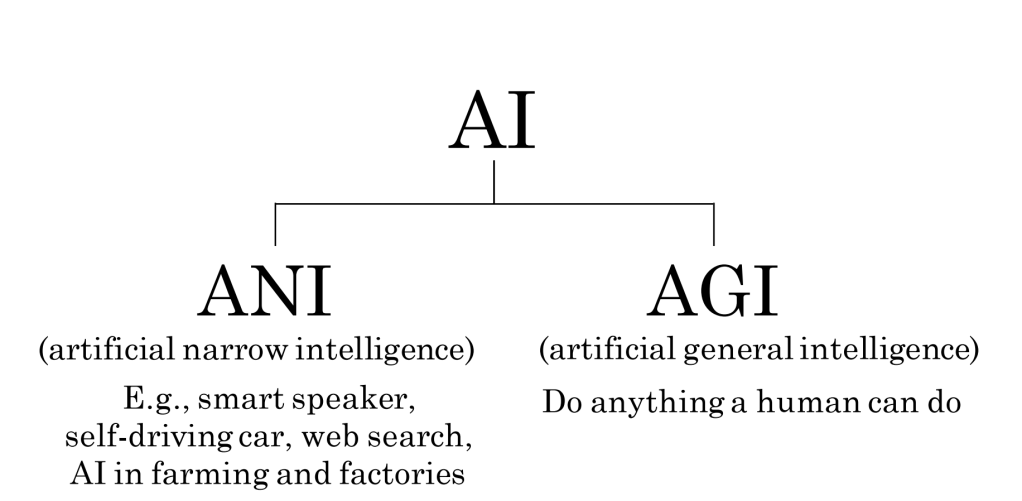
The journey from Artificial Narrow Intelligence (ANI) to Artificial General Intelligence (AGI) represents one of the most ambitious and profound quests in the field of artificial intelligence. This voyage is not merely a technical endeavor but a journey towards realizing a dream that has captivated scientists, philosophers, and dreamers alike for decades. The aspiration to create an AI system that rivals human intelligence in its generality and versatility is both a source of inspiration and a monumental challenge. As we stand on the shoulders of today’s technological advancements, it’s crucial to understand the spectrum of artificial intelligence, distinguishing between the tangible achievements of ANI and the elusive horizon of AGI. This blog post aims to explore this distinction, shedding light on the current state of AI and the path that may lead us toward achieving true general intelligence.

The Current Landscape of AI
Artificial Narrow Intelligence (ANI): A World of Specialized Wizards
Today’s AI landscape is dominated by Artificial Narrow Intelligence (ANI), systems designed to perform specific tasks with a level of proficiency that can sometimes surpass human capabilities. These specialized wizards are the workhorses behind some of the most impactful technological innovations of our era. From the voice assistants in our homes to the sophisticated algorithms guiding self-driving cars, ANI has permeated various aspects of our daily lives, often invisibly and seamlessly.
ANI applications are diverse, covering a range of domains such as web search engines that sift through the vast expanse of the internet to deliver precise information, smart agriculture systems optimizing crop yields, and automated manufacturing processes revolutionizing factories. The success of ANI lies in its focus: by concentrating on narrowly defined tasks, these AI systems achieve incredible accuracy and efficiency, creating substantial value across industries.
Progress and Misconceptions
The rapid progress in ANI over the last decade has been nothing short of remarkable. Breakthroughs in machine learning, particularly deep learning, have enabled significant advancements in pattern recognition, natural language processing, and predictive analytics. This progress, however, has led to a widespread misconception about the state of AI as a whole. The leap from mastering specific tasks to achieving a general, human-like intelligence is not merely a matter of scale but a fundamental shift in capability.
While ANI focuses on doing one thing exceptionally well, the dream of AGI is to create systems that can understand, learn, and apply knowledge across a broad range of tasks, adapting to new challenges with the flexibility and ingenuity of a human mind. Despite the excitement and optimism generated by advancements in ANI, the truth remains that we are still far from realizing AGI. The distinction between these two concepts is crucial for setting realistic expectations about the future of AI and guiding research efforts towards meaningful breakthroughs.
As we navigate the current landscape of AI, it’s essential to recognize the achievements and limitations of ANI while keeping the long-term goal of AGI in perspective. This understanding not only frames our expectations but also highlights the vast potential and challenges that lie ahead on the path to achieving artificial general intelligence.
The AGI Dream and Its Challenges
The dream of Artificial General Intelligence (AGI) stretches far beyond the capabilities of today’s AI, envisioning a future where machines can rival human intellect across all aspects of learning, reasoning, and creativity. This vision for AGI is not just about creating technology that can perform tasks with human-like efficiency; it’s about forging an entity that understands and interacts with the world in a way indistinguishable from humans. However, the path to AGI is fraught with unprecedented challenges, both technical and philosophical, that extend the timeline of its realization into an uncertain future.
The Complexity of Human Intelligence
One of the foremost challenges in achieving AGI is the sheer complexity of human intelligence. Our cognitive abilities arise from intricate interactions within networks of billions of neurons, shaped by millennia of evolutionary pressures. Replicating this level of complexity in a machine requires not just an understanding of how individual neurons function but how the emergent properties of consciousness and intelligence arise from the vast networks of these biological units. The endeavor to create AGI thus involves deciphering the deepest mysteries of the human mind, a task that intersects with the realms of neuroscience, psychology, and even philosophy.
The Hype and Its Consequences
Amidst the significant progress in AI, particularly in domains governed by ANI, a narrative suggesting that AGI is just around the corner has gained traction. This hype, often amplified by sensational media coverage and speculative futurism, obscures the reality of the scientific and engineering challenges ahead. While optimism fuels progress, unrealistic expectations can lead to disappointment, eroding public trust and potentially diverting attention and resources from the foundational research required to advance towards AGI.
Ethical Considerations
As we ponder the technical hurdles, we must also confront the ethical implications of creating a machine with human-like intelligence. The prospect of AGI raises profound questions about consciousness, rights, and the societal impact of introducing entities that could eventually outthink us. These considerations add layers of complexity to the AGI endeavor, necessitating a multidisciplinary approach that incorporates ethical guidelines and societal values into the fabric of AGI research.
Simulating Neurons – The Limitations
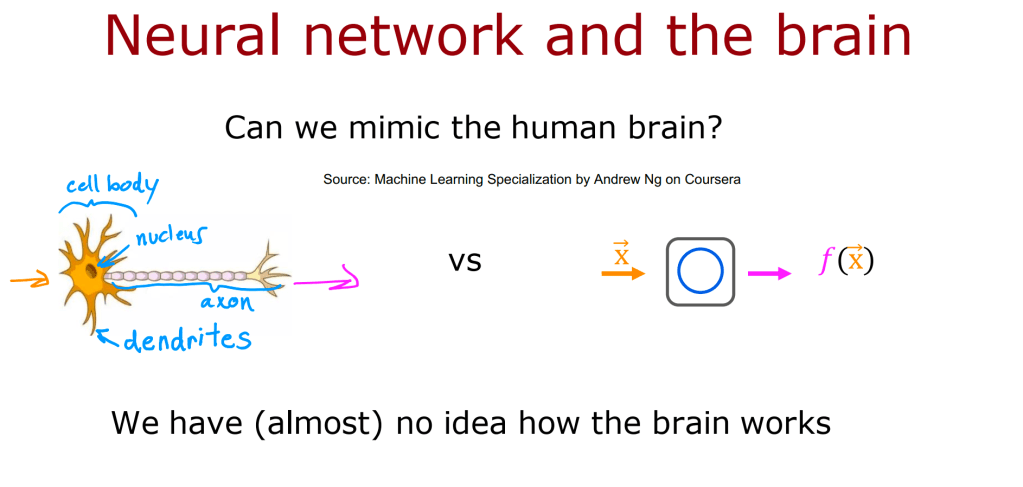
The journey towards artificial intelligence initially sparked hope that simulating the structure of the human brain, neuron by neuron, could lead us to AGI. The advent of modern deep learning and the computational power of GPUs have enabled us to simulate large networks of artificial neurons, offering a glimpse into the potential of neural simulations. However, this approach has encountered significant limitations, highlighting the gap between our technological aspirations and the realities of biological complexity.
The Simplicity of Artificial Neurons
Artificial neurons, such as those used in logistic regression models, are vastly simplified abstractions of their biological counterparts. While these models can capture basic input-output relationships, they lack the dynamic range and adaptability of biological neurons. Biological neurons engage in complex chemical and electrical signaling processes, with each neuron capable of participating in thousands of connections. The richness of these interactions underpins the brain’s ability to process information, learn, and adapt in ways that current artificial models cannot replicate.
Our Limited Understanding of the Brain
Compounding the challenge is our limited understanding of how the brain functions at a detailed level. Despite advances in neuroscience, many fundamental questions about neuronal signaling, brain architecture, and the emergence of consciousness remain unanswered. Without a comprehensive understanding of these processes, attempts to simulate the brain’s functionality are based on incomplete and sometimes inaccurate models. This gap in knowledge presents a formidable barrier to using brain simulation as a direct path to AGI.
The Path Forward
Recognizing the limitations of simulating neurons does not spell the end of the road for AGI but rather clarifies the challenges ahead. It underscores the need for innovative approaches that transcend simple emulation of the brain’s structure. Instead, the focus may need to shift towards understanding the principles of intelligence and consciousness, seeking to abstract these concepts in ways that can be implemented within the computational frameworks of the future.
As we explore the dream of AGI and confront the limitations of current approaches, it becomes evident that the journey towards creating machines with human-like intelligence is not only about technological advancements but also about deepening our understanding of the human mind. This dual pursuit, challenging as it may be, continues to inspire researchers and dreamers alike, driving forward the quest for one of the most profound milestones in the history of human civilization.
Learning from Nature – The Brain’s Adaptability
The quest for AGI takes inspiration from one of the most complex and adaptable systems known: the human brain. Nature’s prowess in creating a learning, adapting, and evolving intelligence offers invaluable insights into the potential pathways toward achieving artificial general intelligence. The brain’s adaptability, or neuroplasticity, reveals a remarkable capacity to reorganize itself, forming new neural connections throughout life in response to new information, sensory input, and development.
Evidence of Neuroplasticity
Groundbreaking experiments have underscored the brain’s versatility, showing that regions traditionally associated with one sensory input can adapt to process entirely different types of information when rerouted with alternative data sources. For instance, studies have demonstrated that the auditory cortex, when exposed to visual signals, can develop the capability to process these signals as if they were sound. Similarly, the somatosensory cortex, responsible for processing touch, can learn to interpret visual data, essentially learning to ‘see’.
These experiments not only challenge our understanding of the brain’s functional fixedness but also suggest that the underlying mechanisms of intelligence and learning may be more universal than previously thought. This adaptability hints at a foundational learning algorithm—a core set of principles or processes—that underlies the brain’s ability to tackle a wide range of tasks, from sensory processing to abstract thinking.
The Hope for a Universal Learning Algorithm
The notion of a universal learning algorithm is a beacon of hope in the journey toward AGI. It suggests that the diversity of human cognitive abilities may emerge not from a multitude of specialized processes but from the application of a few, or possibly even a single, general-purpose learning algorithm. This hypothesis proposes that if we can uncover and understand this algorithm, we could replicate it in artificial systems, paving the way for AGI.
The One Learning Algorithm Hypothesis
The hypothesis gains credence from observations of the brain’s plasticity and the ability of different neural regions to take on new roles. This adaptability implies that the brain does not rely on a vast array of task-specific algorithms but rather on a robust, versatile learning mechanism capable of interpreting and acting upon the world in various ways, depending on the input and experience.
Challenges and Implications
Identifying and understanding such a universal learning algorithm presents a monumental challenge. It requires not only deciphering the intricate workings of the brain but also abstracting these processes into a form that can be implemented computationally. Furthermore, this pursuit raises profound questions about the nature of intelligence itself and the extent to which it can be separated from the biological substrate of the brain.
Despite these challenges, the prospect of discovering a universal learning algorithm offers a compelling direction for AGI research. It suggests a pathway that is not strictly bound to simulating the brain’s exact structure but rather seeks to emulate the principles underlying its learning and adaptability.
Looking Ahead
The quest for a universal learning algorithm embodies the essence of the AGI dream: to create a machine capable of learning and adapting with the generality and flexibility of a human. While the path is fraught with uncertainties, the pursuit itself enriches our understanding of both artificial and natural intelligence. As we venture forward, the lessons learned from nature’s own experiment in intelligence—evolving over billions of years—remain our most valuable guide, inspiring innovative approaches to unlocking the mysteries of AGI.
AGI: The Path Forward
The journey towards Artificial General Intelligence (AGI) is one of the most exhilarating frontiers in the realm of artificial intelligence. As we reflect on the insights gleaned from nature, the limitations of current technologies, and the tantalizing hypothesis of a universal learning algorithm, a multifaceted path forward begins to emerge. This path is not linear nor predictable, but it is guided by a combination of scientific rigor, creative exploration, and a deep ethical consideration of the implications of our endeavors.
Embracing Interdisciplinary Research
The complexity of achieving AGI necessitates an interdisciplinary approach, combining insights from neuroscience, cognitive science, computer science, psychology, and other fields. By understanding the principles that underlie human intelligence and learning, researchers can develop more sophisticated models that may lead us closer to AGI. This collaborative effort can help bridge the gap between biological intelligence and artificial systems, offering innovative strategies that transcend traditional methods.
Advancing Beyond Simulations
While simulating the brain’s structure offers valuable insights, the path to AGI also involves abstracting and implementing the core principles of intelligence in new computational models. This includes exploring novel architectures that are not limited by current understandings of neural networks, potentially leading to breakthroughs in how machines can learn, reason, and interact with their environment in generalizable ways.
Ethical and Societal Considerations
As we advance towards AGI, it is imperative to navigate the ethical landscape with caution and foresight. The development of AGI raises profound questions about consciousness, rights, societal impact, and the potential risks associated with superintelligent systems. Engaging with philosophers, ethicists, policymakers, and the broader public is crucial in shaping a future where AGI can be developed responsibly and for the benefit of humanity.
Fostering Open Dialogue and Collaboration
The pursuit of AGI is not just a technical challenge but a global endeavor that affects all of humanity. Fostering open dialogue, collaboration, and sharing of ideas across borders and disciplines can accelerate progress while ensuring that advancements are aligned with ethical standards and societal values. By working together, the global research community can navigate the uncertainties of AGI development more effectively.
The aspiration to achieve Artificial General Intelligence represents one of the boldest dreams of our technological age. As we stand at the crossroads of significant advancements in artificial narrow intelligence and the vast, uncharted territories of AGI, we are reminded of both our achievements and our limitations. The path forward is shrouded in complexity and ethical considerations, yet it is illuminated by the hope of uncovering the mysteries of intelligence itself.
In this endeavor, we must proceed with humility, recognizing the profound responsibility that accompanies the creation of systems that could one day match or exceed human intelligence. The journey towards AGI is not just a scientific and technological pursuit but a reflection of our deepest aspirations to understand the essence of what it means to think, learn, and be intelligent. As we continue this journey, let us embrace the challenges and opportunities that lie ahead, guided by the principles of interdisciplinary collaboration, ethical integrity, and a steadfast commitment to the betterment of society.
The quest for AGI is a testament to human curiosity and ingenuity, a journey that transcends the boundaries of current knowledge towards the horizon of what might be possible. In exploring this frontier, we are not only striving to create artificial minds but also seeking to deepen our understanding of the very nature of intelligence itself.


💕💕💕💕
BeğenBeğen